Advanced Container Escapes: A Principle-Based Security Deep Dive
Container security doesn’t end with toggling off --privileged or removing cap_sys_admin. Modern attackers probe runtime binaries, exploit…
Container security doesn’t end with toggling off --privileged or removing cap_sys_admin. Modern attackers probe runtime binaries, exploit obscure kernel features, and craft side-channel or man-in-the-orchestrator attacks to compromise entire infrastructures. In this article, we’ll explore advanced container escape scenarios—offering both a red-team vantage (where to dig for weaknesses) and a blue-team perspective (how to systematically defend).
We’ll address:
- Foundational Recap — Revisiting namespaces, capabilities, cgroups in an advanced context
- Advanced Runtime Vulnerabilities — runC, containerd, CRI-O, pivot_root, userfaultfd, real-world CVEs
- High-Level Kernel Abuses — eBPF weaponization, overlayfs injection, side-channel exploits (Spectre/Meltdown)
- Persistence & Evasion Tactics — ephemeral exploits, Trojan runtimes, hooking container daemons
- Attacks on Orchestrators — malicious ephemeral containers, CRI misconfigurations, advanced RBAC bypasses
- Principle-Based Layers — refined boundary analysis, least-path exploitation, zero-trust container model
1. Foundational Recap
We begin with a quick refresher on core container elements, focusing on how advanced attackers often manipulate or circumvent them in ways that go beyond basic misconfigurations.
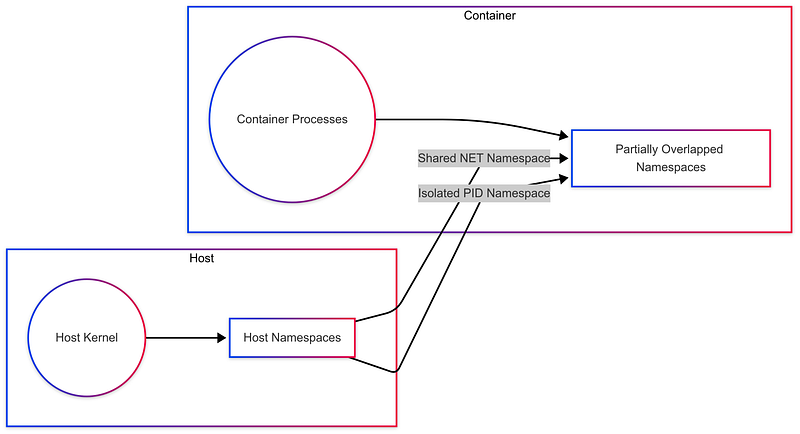
Namespaces: More Than PID and NET
Linux namespaces are commonly summarized as PID, NET, MNT, IPC, UTS, and USER. However, advanced threats often:
- Partially Overlap Namespaces: A container might have an isolated PID namespace but share a NET namespace with the host, enabling network sniffing or packet injection.
- Exploit USER Namespace Confusion: Certain older kernels or partial user namespace mappings can reveal system-level UIDs or open unexpected file access routes.
- Leverage Nested Namespaces: Attackers may chain container-in-container setups, escaping from a lower layer to the next until reaching the host.
Tip : Always inspect namespace mappings using tools likelsnsor by reviewing/proc/[pid]/ns. Even a partial namespace share can open a pivot path to the host.
Capabilities: Scattered Pieces of Root
Capabilities break root privileges into smaller, targeted rights:
CAP_CHOWN+CAP_FSETID: Can manipulate ownership and setuid bits in hidden ways.CAP_NET_RAW: Lets attackers craft raw packets, potentially sniff or ARP-spoof on the host network.CAP_SYS_RESOURCE: Might allow modifying or bypassing cgroup resource limits at the host level.
Tip: Don’t ignore the “lesser” capabilities. Combined in the right environment, they create unintended high-privilege outcomes.
Cgroups: The Hidden Resource Gate
Control groups (cgroups) manage CPU, memory, and device usage. Under cgroups v2, multiple controllers are unified, offering both new features and new attack angles. Attackers can:
- Attach to Host-Level Controllers: If container cgroups share or link to the host’s cgroup tree, attackers might override host resource limits.
- Hijack Freed Scope: Some orchestrators fail to clean up cgroup references, letting an attacker latch onto leftover cgroup handles.
2. Advanced Runtime Vulnerabilities
Container escapes frequently involve the underlying runtime: runC, containerd, CRI-O, or Docker’s daemon.
runC Exploits (CVE-2019–5736 and Beyond)
A major vulnerability in runC let attackers overwrite the host runC binary by abusing /proc/self/exe. Though patched in most environments, forks or partial patches persist.
Example Attack Snippet (Simplified):
# Overwriting the host runC binary via /proc/self/exe
cp /malicious_runc /proc/self/exe
# Once replaced, new containers run attacker code on the host
Tip: Always check for forked or outdated runC versions in custom container deployments. They often miss critical patches.
Containerd & CRI-O Hook Attacks
Runtimes like containerd and CRI-O rely on hooks to perform tasks before or after container start. If a post-start hook is misconfigured:
# containerd.toml snippet
[plugins."io.containerd.grpc.v1.cri".containerd.runtimes."evil-runc"]
  runtime_type = "io.containerd.runc.v2"
  privileged_without_host_devices = false
  # A malicious runtime can be injected here to compromise all future containers
Attackers can replace the default runtime or add scripts that execute host-level commands whenever a new container launches.
pivot_root & chroot Jumps
Containers perform pivot_root or chroot to swap their root filesystem. In advanced attacks, a leftover mount or misconfigured proc directory can let attackers pivot into a host directory, write data, and pivot back—leaving minimal footprints.
userfaultfd Manipulation
userfaultfd offloads page faults to user space. With partial privileges (CAP_SYS_ADMIN) or specific seccomp allowances, attackers can intercept page faults and inject code into memory
// Basic userfaultfd setup snippet (abridged)
int fd = syscall(SYS_USERFAULTFD, O_CLOEXEC | O_NONBLOCK);
/* map memory, register fault region, handle page faults in user space */
Tip : If you see userfaultfd usage in a container that shouldn’t normally handle page faults, investigate. This can be used for fileless malware or stealth memory modifications.
3. High-Level Kernel Abuses
Beyond container runtimes lie advanced kernel-level tactics. With sufficient privileges (or overlooked capabilities), attackers can effectively “own” the host kernel from inside a container.
eBPF Weaponization
eBPF allows user-defined code to run in the kernel for monitoring or networking. Misused eBPF can:
- Hook Syscalls: Attackers can intercept and filter out their malicious syscalls from logs.
- Create Covert Channels: eBPF “maps” might store stolen data or facilitate container-to-host exfiltration.
- Persistent Rootkits: Once loaded, a malicious eBPF program can remain active indefinitely, even if the container restarts.
OverlayFS Injection
Container images rely on overlay filesystem layers. A misconfiguration or bug in overlayfs can expose host directories or let attackers manipulate the container’s upperdir:
# Overwriting a critical host file from within the container
mount -t overlay overlay -o lowerdir=/some/host/dir,upperdir=/mnt/upper,workdir=/mnt/work /merged
# If /some/host/dir was bind-mounted, the attacker can merge and overwrite the host content
In older Docker versions or custom setups, such merges can replace host binaries silently.
Side-Channel Exploits (Spectre, Meltdown, and Beyond)
Even if the container boundaries are tight, side-channel vulnerabilities can leak secrets:
- Cache Timing to extract cryptographic keys from co-located processes.
- Speculative Execution Attacks to read host memory despite isolation patches.
Tip (: On multi-tenant setups, attempt micro-timing or cache-based analysis. Under certain conditions, you can glean critical data from other containers or the host.
4. Persistence & Evasion Tactics
Advanced attackers don’t just break in; they aim to stay in — often while hiding from detection.
Ephemeral Exploits and In-Memory Payloads
Containers frequently store data in ephemeral volumes like tmpfs or ramfs. Attackers:
- Inject Malicious Binaries into tmpfs so they vanish on container restart.
- Use LD_PRELOAD or userfaultfd-based injection to load malicious libraries purely in memory, bypassing disk-based detection.
# Example of ephemeral injection
cp /host/malicious_lib.so /dev/shm/malicious_lib.so
LD_PRELOAD=/dev/shm/malicious_lib.so /usr/bin/legit_app
No permanent file is left on the container’s underlying storage.
Trojan Runtimes and Hooking Container Daemons
If attackers gain host-level privileges:
- Replace Dockerd or containerd binaries so every new container is compromised.
- Install Trojan CNI Plugins that intercept or inject data into container traffic.
- Modify Systemd Services to relaunch malicious runtimes on reboot.
Tip : Once you’re on the host, hooking the container runtime is often more efficient than patching each container individually.
Disabling or Spoofing Audit Logs
Attackers can manipulate auditing at the kernel level:
- seccomp: Custom filters can block or truncate crucial syscalls from logging.
- eBPF or LSM: Malicious eBPF or a custom LSM hook can intercept and nullify audit events — e.g., hide certain file writes or pivot_root calls.
5. Attacks on Orchestrators
Malicious Ephemeral Containers
Kubernetes ephemeral containers are commonly used for debugging, but:
# Example ephemeral container creation (Kubernetes >= v1.23)
kubectl debug my-deployment-12345 \
  --image=alpine:latest \
  --target=my-deployment-container \
--attach- Sometimes ephemeral containers run with higher privileges than the original pod.
- Security teams often forget to apply PodSecurityPolicies or admission controls to ephemeral containers.
Advanced RBAC Bypasses
Attackers scour Kubernetes RBAC for wildcard or mislabeled roles:
- ServiceAccounts with cluster-admin privileges in dev namespaces.
- Hidden Bindings that grant unsuspecting pods the ability to create privileged pods or ephemeral containers in production.
- Unused Roles accidentally left behind that still have wide privileges.
CRI Misconfigurations (containerd, CRI-O)
The Container Runtime Interface (CRI) can store config files for custom runtimes or registry endpoints:
# /etc/crio/crio.conf
insecure_registries = [
  "attacker-registry.example.com"
]
A misconfigured “insecure registry” allows attackers to serve malicious images that appear legitimate, leading to cluster-wide compromise.
6. Principle-Based Layers for Advanced Defense
By now, it’s clear that advanced container security requires more than a short checklist. A principle-based approach ensures you can adapt to newly discovered exploits or runtime changes.
Refined Boundary Analysis
- Execution Boundary
- Evaluate ephemeral debugging containers, runtime hooking (runC, containerd), userfaultfd usage.
- Look out for nested or partially shared namespaces in custom microVM setups.
2. Resource Boundary
- Validate overlayfs merges, cgroup2 controllers, ephemeral volumes for hidden writes.
- Confirm that host bind mounts are strictly read-only when absolutely necessary.
3. Identity Boundary
- Audit user namespace mappings thoroughly.
- Meticulously verify each Linux capability. Even
CAP_NET_RAWorCAP_SYS_RESOURCEcan be escalated.
4. Control Boundary
- Hard-check ephemeral container creation paths, orchestrator-level debug endpoints, and advanced RBAC rules.
- Orchestrators are prime targets for pivoting from single-container compromise to the entire cluster.
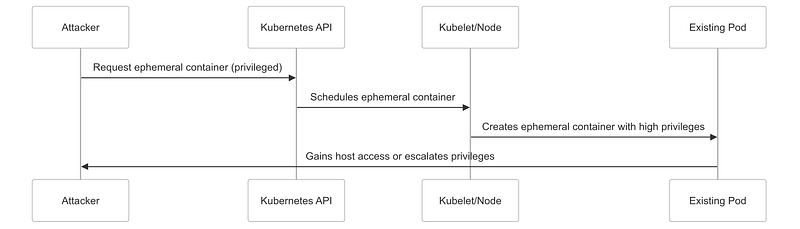
Least-Path Exploitation: The Advanced Case
With so many possible angles — runC exploits, eBPF rootkits, ephemeral container creation — an attacker picks whichever requires the fewest steps. This is why even a single unpatched runtime or overlooked ephemeral container policy can undo layers of defense.
Zero-Trust for Runtimes
Standard zero-trust container models assume a compromised container. Extend that mindset to the container runtime and orchestrator**:
- Periodic Integrity Checks on Docker, containerd, or CRI-O binaries.
- Immutable Infrastructure: All updates must flow through a CI/CD pipeline with code reviews.
- Restricted Debug Tools: ephemeral containers and
kubectl execshould be monitored, logged, and limited to privileged admins.
Conclusion
Container escapes have grown beyond the “mount /var/run/docker.sock” or “run as --privileged” era. Attackers now exploit kernel features (userfaultfd, eBPF), manipulate container runtimes (runC, containerd, CRI-O), and compromise orchestrators with ephemeral containers or RBAC bypasses to break isolation and gain cluster-wide dominance.
A principle-driven model — covering execution, resource, identity, and control boundaries — offers the most robust defense against these advanced tactics. By monitoring runtime integrity, locking down ephemeral containers, and limiting kernel-level privileges, you’ll stay ahead of rapidly evolving container exploits.
About the Author
Kai Aizen is a cybersecurity specialist, Social Engineer lecturer, and Offensive Security Analyst heavily inspired by Kevin Mitnick. Under the PTSnails | Research Team he explores new threat vectors spanning container runtimes, orchestrators, and AI-driven attacks. Connect with Kai Aizen on LinkedIn for professional insights and cutting-edge research.